Effective Date: 1 March 2026
The Malaysian Business Reporting System 2.0 (MBRS 2.0) is the Companies Commission of Malaysia's (SSM) digital
platform for preparing and lodging annual statutory documents. It replaces paper/PDF filing for documents within its
scope with structured data in eXtensible Business Reporting Language (XBRL). It applies to Malaysian-incorporated
and registered foreign companies.

The principal submissions are Annual Returns (AR), Financial Statements and Reports (FS), and related Exemption
Applications (EA). Financial information is mapped to SSM's taxonomy, aligned with the Companies Act 2016 and
Malaysian accounting frameworks, including MPERS and MFRS. The objective is to improve the consistency, validation
and analysis of corporate information.
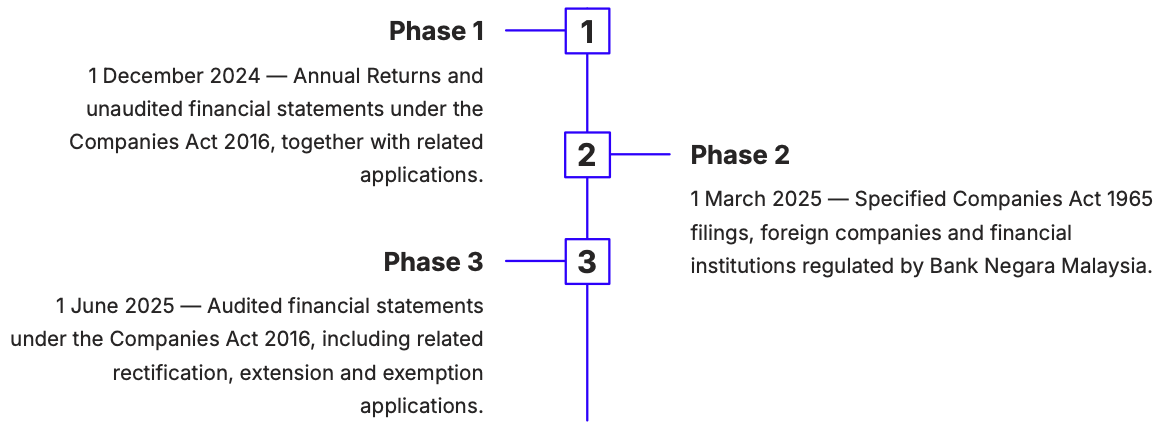
SSM introduced mandatory filing in three phases. Phase 1 began on 1 December 2024 and covered Annual Returns and
unaudited financial statements under the Companies Act 2016, together with related applications. Phase 2 began on 1
March 2025 and extended the requirement to specified Companies Act 1965 filings, foreign companies and financial
institutions regulated by Bank Negara Malaysia.
Phase 3 began on 1 June 2025 and made audited financial statements under the Companies Act 2016, including related
rectification, extension and exemption applications, mandatory through MBRS 2.0.
Management should confirm the company's filing requirements and deadlines with its company secretary.
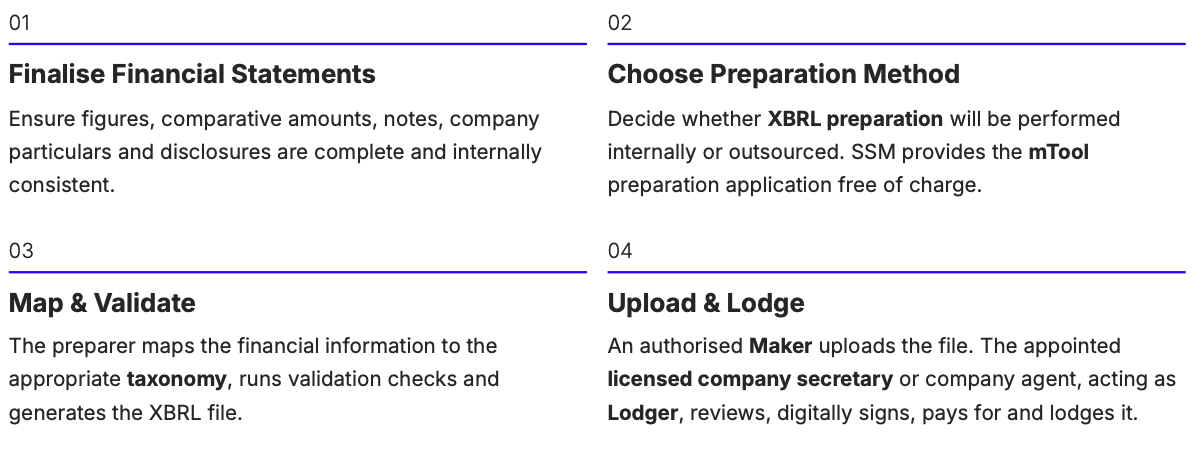
XBRL preparation is more than transferring figures from signed accounts into a template. Financial statement line items
and disclosures must be mapped to the correct SSM taxonomy elements. Differences between the signed financial
statements and tagged data, inappropriate mapping, incomplete disclosures or unresolved validation errors can delay
acceptance and require rework.
For many SMEs, this is also a once-a-year exercise. Training an employee may not be cost-effective when the
knowledge is used infrequently. Outsourcing to a company secretary, external accountant or specialist provider can
provide experienced mapping and validation support.
However, outsourcing does not transfer management's responsibility for the accuracy and timely submission of
company information. The engagement scope should clearly state who prepares, reviews and approves the information,
resolves validation errors and completes the lodgement.
Management should maintain a central accommodation register covering:
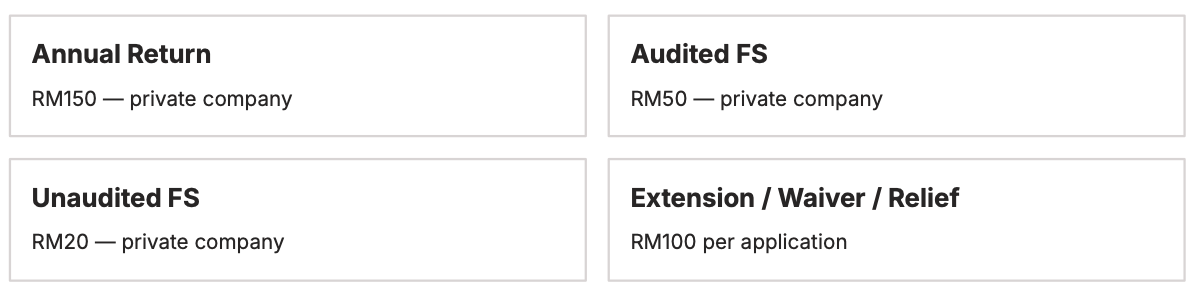
The software is free, but statutory submission fees remain payable. SSM currently lists RM150 for a private-company
Annual Return; RM50 for audited and RM20 for unaudited private-company financial statements; and RM100 for each
extension, waiver or relief application. These exclude late-lodgement charges and professional fees.
External XBRL preparation fees are not fixed by SSM. Indicative market charges may range from a few hundred ringgit
for a straightforward standalone SME to RM1,500 or more for consolidated, complex or urgent accounts. Companies
should obtain itemised quotations and confirm whether preparation, validation corrections and lodgement are included.
Internal preparation reduces external fees but requires training and review time.
MBRS 2.0 is a compliance requirement, not a future initiative. Management should appoint a process owner,
coordinate the finance closing timetable with the company secretary, choose an internal or outsourced model,
budget for statutory and professional costs, and allow sufficient time for mapping, validation and corrections
before the filing deadline.