Effective Date: 30 Jun 2026

The Ministry of Finance (MOF) and the Inland Revenue Board of Malaysia (IRBM) have extended the Special Voluntary Disclosure Programme for Stamp Duty (SVDP 2026) from 30 June 2026 to 31 December 2026.
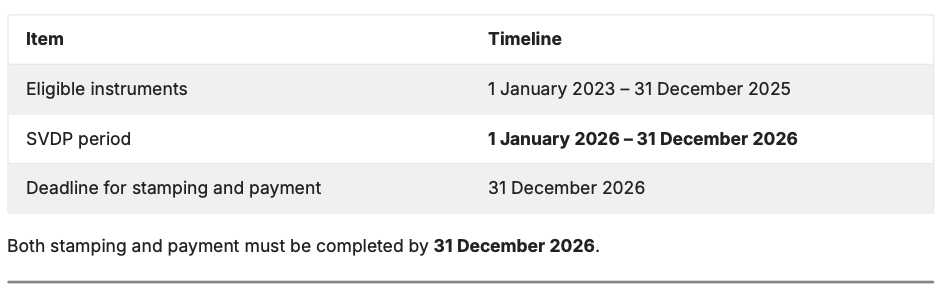
The extension gives businesses an additional six months to regularise unstamped or late-stamped instruments executed between 1 January 2023 and 31 December 2025, while enjoying a 100% waiver of late stamping penalties. It also provides taxpayers with additional time to transition to the Stamp Duty
Self-Assessment System (STSDS).
Stamp duty is a tax imposed on specified legal instruments under the Stamp Act 1949. It is payable on documents that create, transfer or record legal rights and obligations.
While many businesses associate stamp duty primarily with property transactions, the scope is much wider. Various commercial, financing and employment-related documents may also attract stamp duty. Failure to stamp a chargeable instrument within the prescribed timeline may result in late stamping penalties and affect the document's admissibility as evidence in legal proceedings until the applicable duty and penalties have been paid.
Reference:
(i) Quick Bites (4) Stamp Duty Self-Assessment System (STSDS)
(ii) Quick Bites (5) Stamp Duty Comparison (Before & After 1 January 2026)
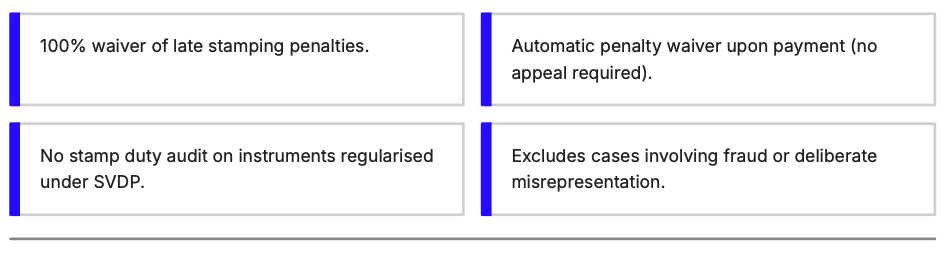
SVDP 2026 allows eligible instruments executed between 1 January 2023 and 31 December 2025 to be stamped without late penalties, provided both stamping and payment are completed by 31 December 2026.
The programme offers:
Under the Stamp Duty Self-Assessment System, taxpayers are responsible for determining the applicable stamp duty, submitting documents electronically and making payment through the IRBM e-Stamp Duty System.
Manual submissions are no longer accepted for SVDP 2026 applications. Businesses should ensure they have the necessary internal processes and supporting documents ready before submission. As assessment and payment must be completed by 31 December 2026, companies should avoid last-minute filings that may leave insufficient time for processing.
Many organisations focus on sale and purchase agreements while overlooking routine commercial documents that may also require stamping.
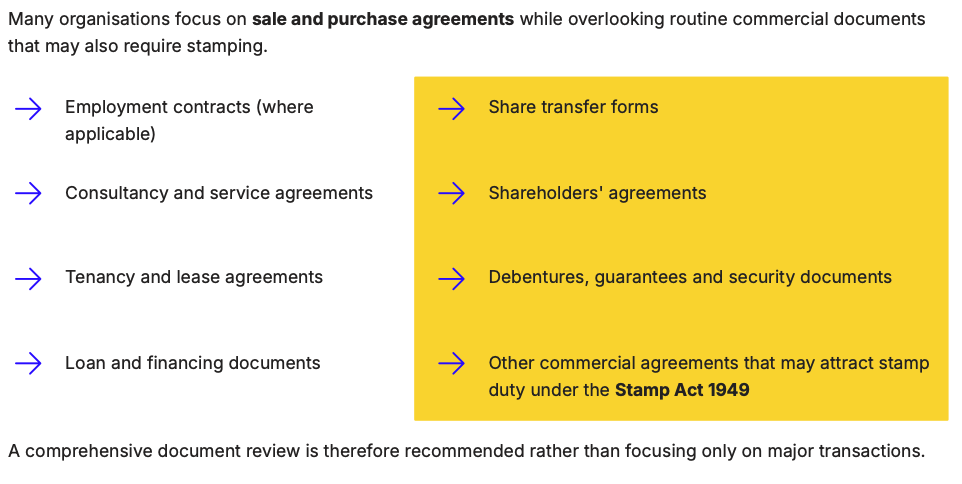
One key advantage of SVDP is that eligible instruments successfully regularised under the programme will not be selected for stamp duty audit.
However, this protection applies only to instruments disclosed under SVDP. It does not prevent IRBM from auditing other unstamped or incorrectly stamped documents. Companies that choose not to participate may remain exposed to future audits, late stamping penalties and additional compliance costs.
Management should act promptly by:
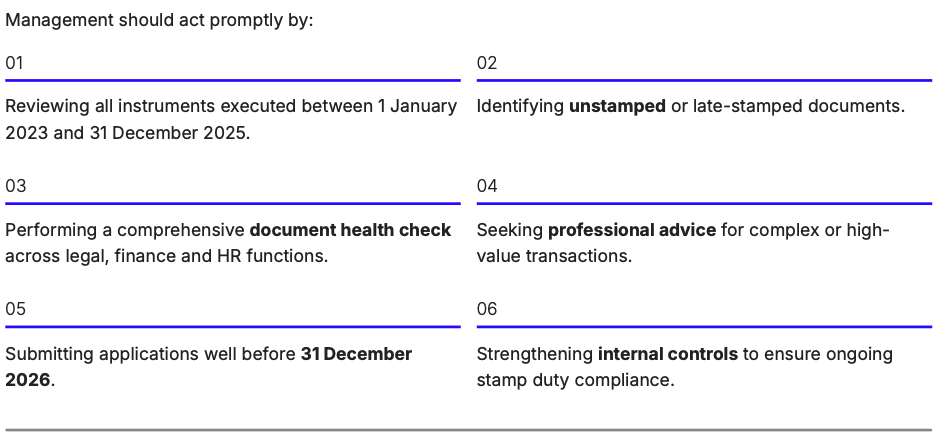
Review now, disclose voluntarily and complete stamping before 31 December 2026 to eliminate
penalties and reduce future stamp duty audit exposure.