Effective Date: 1 March 2026
Malaysia's Employees' Minimum Standards of Housing, Accommodations and Amenities Act 1990 (Act
446) regulates employee accommodation, including minimum standards, certification and related
employer obligations. It applies in Peninsular Malaysia and the Federal Territory of Labuan.
A key 2026 change is the increase in the maximum accommodation charge from RM100 to RM150 per
worker per month, effective 1 March 2026.
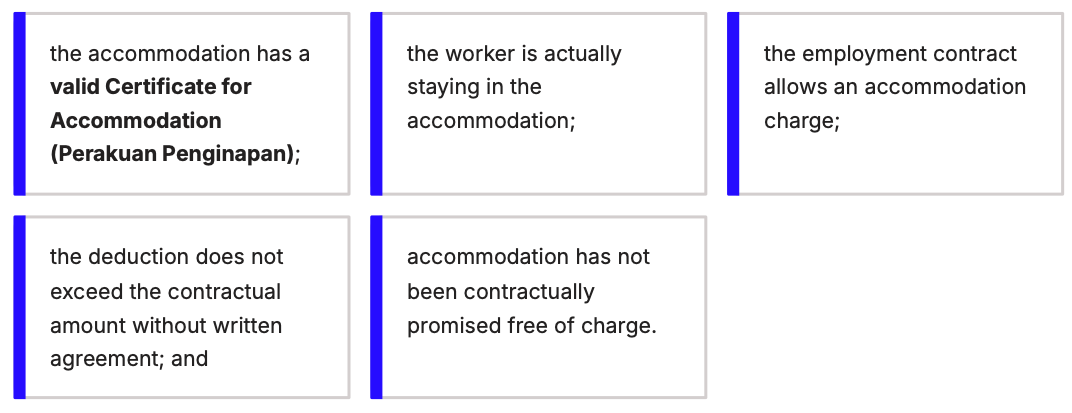
Employers should not automatically increase existing accommodation deductions to RM150. Before
implementation, HR and Payroll should confirm that:
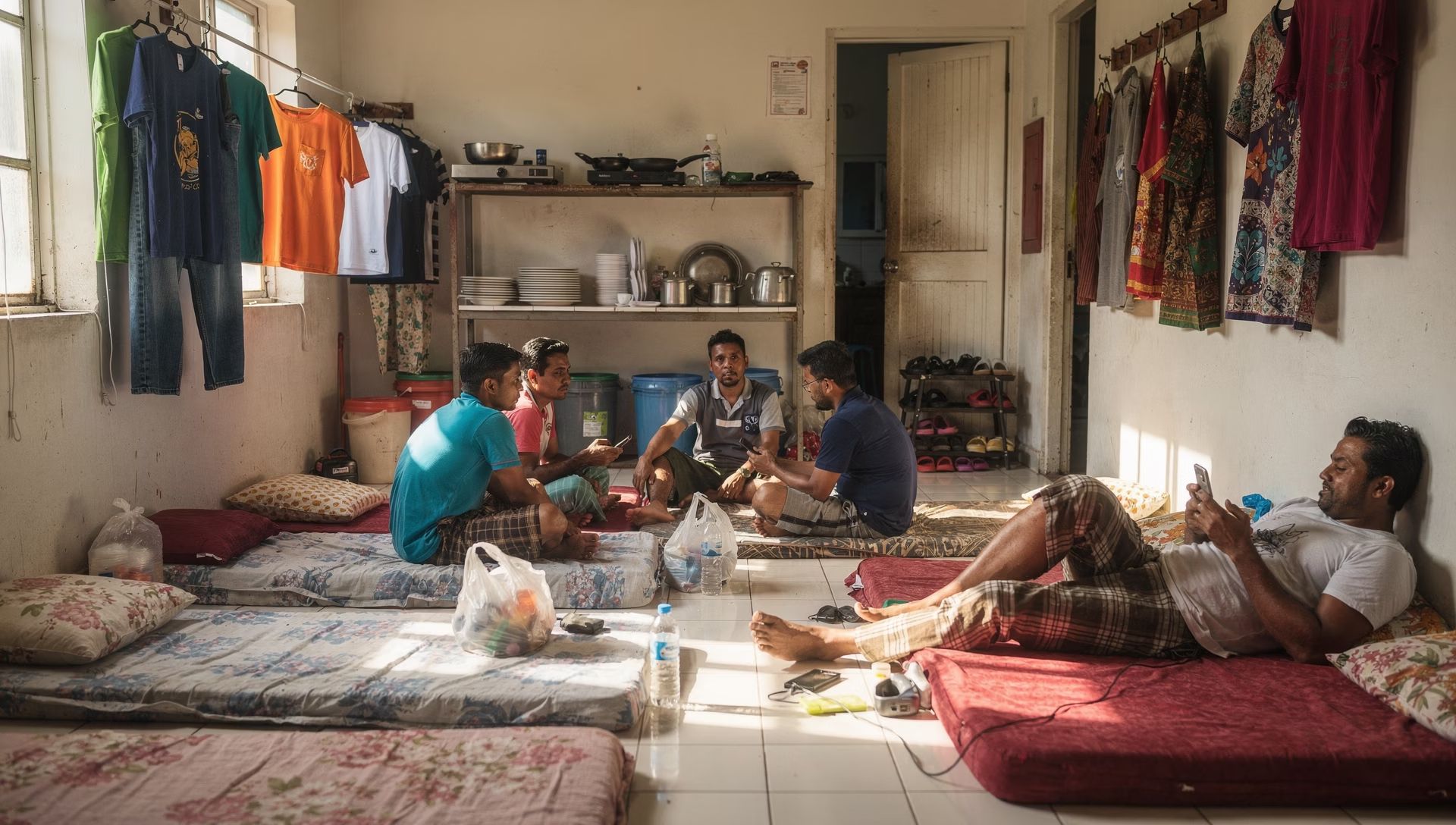
Importantly, an accommodation deduction cannot be made where the accommodation does not have
a valid Certificate for Accommodation. This also applies to workers placed in centralised
accommodation managed by an external provider.
The new RM150 ceiling does not automatically override existing employment terms.
For example, where an employment contract specifies RM100 per month, the employer should not
increase the deduction to RM150 without first obtaining the worker's written agreement to amend the
relevant terms.
Similarly, if the contract provides for free accommodation, a charge should not be introduced without
first varying the contractual arrangement with the employee's written agreement.
Where the contract is silent or unclear, employers should review the terms and applicable wagededuction
requirements before making any deduction.
Employers should also avoid treating RM150 as a basic rental charge and adding separate
deductions for facilities provided as part of the accommodation.
Required accommodation facilities are generally the employer's responsibility and should not be
separately charged to workers. Multiple payroll deductions that effectively push the accommodation
cost beyond the permitted amount may create compliance risk.
For centralised accommodation, the provider's commercial invoice and the amount legally
deductible from employees should also be treated separately. Employers should not simply pass the
provider's cost directly to workers.
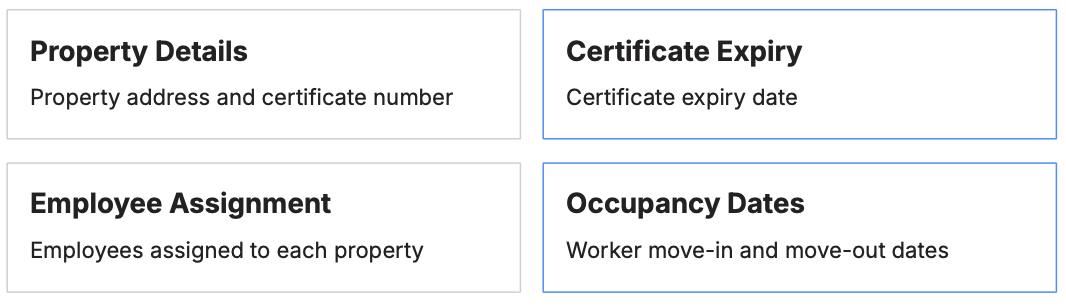
Management should maintain a central accommodation register covering:
Employers should also ensure that required notifications on the placement of workers are made
within the prescribed timeframe. Failure to comply with accommodation certification or reporting
requirements may expose the company to enforcement action and financial penalties.
Management should initiate a focused HR–Payroll–Facilities review before applying the new rate.
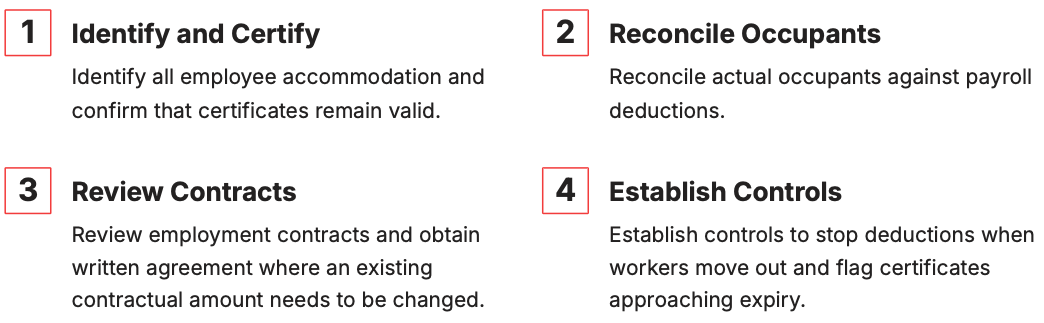
Payroll records should clearly identify accommodation deductions, while supporting documents—
including contracts, written amendments, certificates and occupancy records—should be retained for
audit and inspection.
The increase to RM150 effective 1 March 2026 gives employers a higher permissible ceiling for
accommodation charges, but it does not provide blanket authority to deduct RM150 from every worker.
The practical compliance test requires Management to consider and confirm the following:

Key Takeaway: Management should therefore treat the 2026 change as a trigger to review
existing accommodation and payroll arrangements rather than simply changing the deduction
amount.